
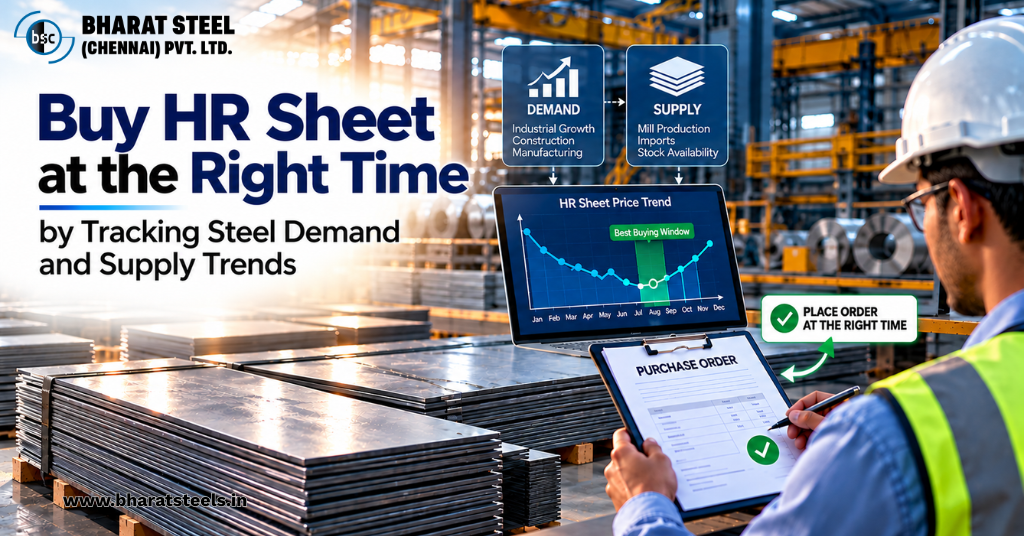
Knowing when to buy HR sheet helps businesses plan purchases around market conditions, stock availability and production schedules. HR sheets are widely used across fabrication, industrial equipment, infrastructure and construction projects, making their availability closely connected to the pace of ongoing industrial activity. Steel demand fluctuates throughout the year.
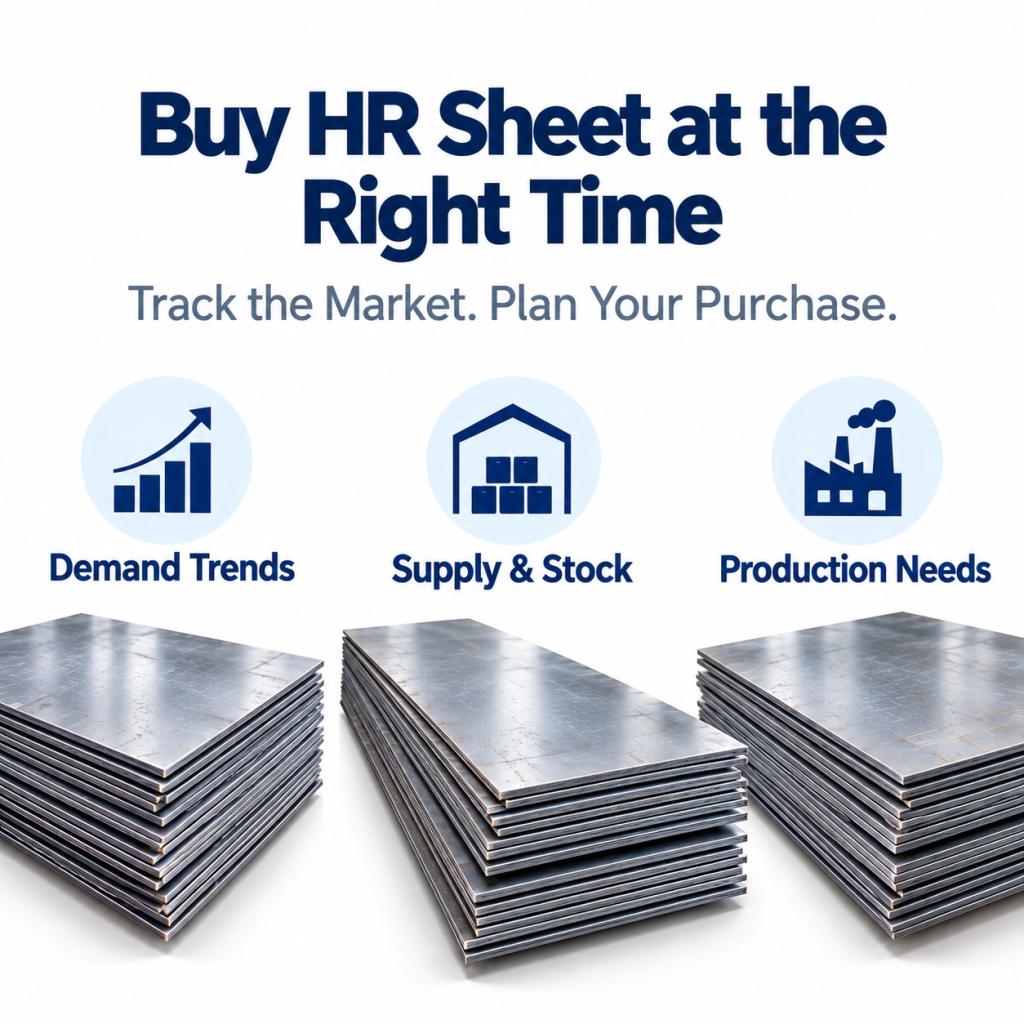
HR sheet procurement is influenced by shifts in industrial output, building activity and major infrastructure investments. These developments can change mill production priorities and the availability of specific material dimensions. When market activity picks up, buyers may need to plan earlier to secure the required specifications within their project timelines.
Tracking HR sheet price trends alongside expected consumption helps buyers plan purchases around changing market conditions and upcoming project requirements.
At Bharat Steel Pvt. Ltd., HR sheets serve a wide range of industrial and fabrication applications. Businesses purchasing these materials can make more informed sourcing decisions by comparing current market movements with their consumption patterns and upcoming project schedules.
How to Buy HR Sheet Based on Steel Market Trends
A steel buyer can receive two quotations for the same HR sheet within a short period and still wonder why the numbers have changed.
There may be no changes in the drawing, the required thickness, or even the quantity.
When to Buy HR Sheet for Optimal Procurement
For companies that buy HR sheet regularly, procurement involves balancing changing market conditions with ongoing material requirements. Steel prices respond to a wider chain of events — mill production, raw material costs, construction activity, manufacturing demand, imports, inventory levels and the pace at which buyers are placing fresh orders.
The challenge is not to predict the market perfectly. It is to understand what is happening around it and recognise when a purchase needs immediate attention.
How to Buy HR Sheet by Understanding Price Trends
By the time a change becomes obvious on a quotation, several things may have already happened upstream.
Steel mills may have adjusted production. Raw material costs may have moved. Large infrastructure or manufacturing orders may have increased consumption. Distributors may have started replenishing their inventories after a period of strong sales.
These developments do not always affect every steel product in exactly the same way.
That is why watching a single daily rate is rarely enough. A buyer needs to understand the direction of the market and the forces behind it.
How HR Sheet Price Trends Reflect Steel Demand
Consider a fabrication company preparing for a busy production cycle.
Although available inventory may meet present demand, upcoming project schedules and confirmed orders should also be considered when deciding how much additional material to procure. If other manufacturers are also increasing their activity, demand for flat steel products can strengthen.
Demand therefore provides an important early signal.
Changes in industrial production and infrastructure activity can affect the right time to buy HR sheet, as both influence steel consumption across different sectors. Buyers can use these market signals alongside their own order forecasts when planning purchases.
How Supply Conditions Affect Your Decision to Buy HR Sheet
The other factor is how much steel is available to meet that demand.
Before businesses buy HR sheet, they should consider mill output, import arrivals and distributor inventory, as these factors affect material availability.
Production schedules, mill maintenance, imported material, port activity and inventory held within the distribution network can all influence the amount of HR sheet available to buyers at a particular time.
A period of strong demand does not automatically mean that prices will rise sharply. If supply remains comfortable, the market may absorb the additional consumption.
Similarly, weaker demand does not guarantee an immediate reduction.
Why Inventory Levels Matter
Before you buy HR sheet, review the stock already available and compare it with upcoming consumption. This helps identify genuine shortages and determine whether additional quantities need to be sourced.
When planning to buy HR sheet, procurement teams should review available inventory to understand which dimensions can be sourced within the required timeframe.
This is particularly relevant when the requirement is specific. A general shortage in the market and difficulty finding the exact sheet dimensions required for a fabrication job are not necessarily the same thing.
The Difference Between Buying Early and Buying Too Early
Buying ahead can protect a production schedule, but purchasing excessively early can create a different problem.
Money is tied up, storage space must be managed, and the material eventually needs to be matched with a specific production need.
The objective is therefore not simply to buy as early as possible.
Instead, it is about identifying the right time to secure the requirement, where the benefit of having it now outweighs the cost of waiting.
This decision depends on factors such as the certainty of the project, how the material will be used, available storage space, and current market conditions.
A Fabricator Sees the Market Differently
A fabricator with a confirmed production schedule has a different purchasing position from a trader holding stock for future resale.
If the plates are already linked to a confirmed job, the buyer knows approximately when they will be consumed. This makes it easier to evaluate whether securing the requirement now makes operational sense.
For an uncertain future requirement, however, holding large quantities simply because the market appears favourable may not be the right approach.
The same market can therefore lead to different decisions for different businesses.
How HR Sheet Dimensions Influence Procurement Decisions
Steel demand and supply trends is not only about the broad market direction.
The exact requirement matters.
A buyer looking for commonly available sizes may have more sourcing options than someone needing a less frequently stocked dimension. Thickness also affects what is available within the supply chain.
This creates an important distinction:
A favourable market does not automatically mean every HR sheet requirement will be equally easy to source.
Understanding the specific requirement before entering the market gives the purchasing team a clearer idea of what to expect.
When Large Orders Make Sense
Large-volume purchases can provide advantages when consumption is predictable and the material will move steadily into production.
They can also reduce the number of separate purchasing cycles and help maintain continuity for repetitive fabrication work.
But volume alone should not determine the decision.
If production is uncertain or the material will remain unused for a long period, a large purchase can increase inventory exposure.
The better question is not “Can we buy more?” but “How much of the requirement is sufficiently certain to secure now?”
Watch the Signals That Matter
A procurement team does not need to follow every development in the global steel industry.
A smaller set of indicators can provide useful context:
- Movement in raw material costs
- Domestic mill production and maintenance activity
- Import arrivals and availability
- Manufacturing and infrastructure activity
- Distributor inventory levels
- Changes in enquiry volumes
- Lead times for specific sizes
- The organisation’s own consumption forecast
None of these indicators should be treated as a standalone prediction. Their value comes from looking at them together.
Why Daily Rates Can Be Misleading
A buyer may see a rate change and immediately assume that the market has entered a new trend.
But a single movement does not necessarily establish a direction.
Buyers deciding when to buy HR sheet should compare quotations alongside stock availability, order quantities and delivery terms rather than relying on one quoted rate.
Looking at the broader pattern over time provides better context than reacting to one number.
This is especially important for companies making recurring purchases.
The Purchase Calendar Should Follow Production
One of the most useful improvements a procurement team can make is connecting its steel buying calendar with the production schedule.
Suppose a fabrication order is expected to consume HR sheets over several stages. Instead of treating the entire requirement as one purchase decision, the buyer can identify which portion is firm, which portion is approaching, and which portion remains uncertain.
This creates room to respond to market conditions without allowing purchasing decisions to interfere with production.
In other words, market awareness works best when it is connected to operational planning.
What to Consider When You Buy HR Sheet
Market awareness becomes more useful when buyers have a supplier who can provide practical information about the current sourcing environment.
For an industrial buyer, the conversation can cover more than a rate. It can include available dimensions, sourcing timelines, processing possibilities and the feasibility of meeting the requirement within the required window.
A well-informed supplier conversation can help the purchase team understand what is available in the market rather than making decisions based only on a number received by email.
A Better Way to Decide When to Buy
There is no universal day on which HR sheets become cheaper or more expensive.
Instead, a sensible purchase decision comes from combining three views:
What is happening in the market?
What is happening inside the business?
How soon will the material actually be used?
When demand is strengthening, inventories are tightening and a confirmed production requirement is approaching, waiting may carry more uncertainty.
When the requirement is still tentative and market availability is comfortable, maintaining flexibility may be more appropriate.
The decision becomes clearer when these factors are considered together.
From Market Watching to Better Procurement
Steel demand and supply trends are useful not because they allow buyers to predict every movement, but because they provide context for making decisions before a requirement becomes urgent.
For businesses planning to buy HR sheet, the real advantage comes from linking market awareness with production schedules, available inventory and the required specifications
The goal is not to find the mythical “perfect buying day.”
It is to recognise the right moment for your requirement.
This is where an integrated Pre-Engineered Building approach can be valuable. Companies planning industrial facilities can explore Metfraa’s PEB building solutions for projects where structural design, fabrication and erection need to be coordinated around the building’s operational requirements.
Conclusion
The right time to buy HR sheet depends on market conditions, confirmed material requirements and the production schedule. Businesses planning to buy HR sheet should consider current prices, material availability and confirmed production requirements before placing an order.
But market signals become useful only when they are connected to an actual production requirement.
By tracking these trends alongside upcoming fabrication schedules and working with an experienced steel sourcing partner, businesses can reduce last-minute purchasing pressure and make more informed decisions about when to secure their HR sheet requirements.
Reviewing HR sheet price trends with actual consumption forecasts gives procurement teams a stronger basis for deciding when and how much material to purchase.
For your upcoming HR sheet requirement, contact Bharat Steel Chennai to discuss the required specifications, sizes and sourcing options for your application.
Frequently Asked Questions
1.Does steel demand directly determine HR sheet prices?
Demand is one of several factors influencing market conditions. Supply levels, raw material costs, imports, production activity and inventory can also affect the price environment.
2. Should HR sheets always be purchased when prices appear low?
Not necessarily. The decision should also consider how certain the requirement is, when the sheets will be consumed and the cost of holding inventory.
3.Why does HR sheet availability vary by size?
Different dimensions and thicknesses may have different levels of demand and stocking within the distribution network. Less frequently traded combinations may require additional sourcing time.
4. How can a business track steel market trends?
Businesses can monitor mill activity, raw material movements, imports, industrial demand, inventory conditions and changes in sourcing timelines while also reviewing their own consumption forecasts.
5. Does Bharat Steel supply HR sheets for industrial and project requirements?
Yes. Bharat Steel Pvt. Ltd. supplies HR sheets and HR coils for industrial, fabrication and project requirements, helping businesses plan their steel procurement based on required specifications and quantities.