
The structural calculation is only the starting point. A beam also needs to work smoothly through NPB Beams are increasingly considered for industrial steel applications where section geometry, structural capacity and fabrication practicality need to work together.
A section may look suitable from an engineering perspective, but its real practicality depends on how effectively it fits into the complete construction process.
This is one reason NPB Beams deserve attention in industrial steel construction.
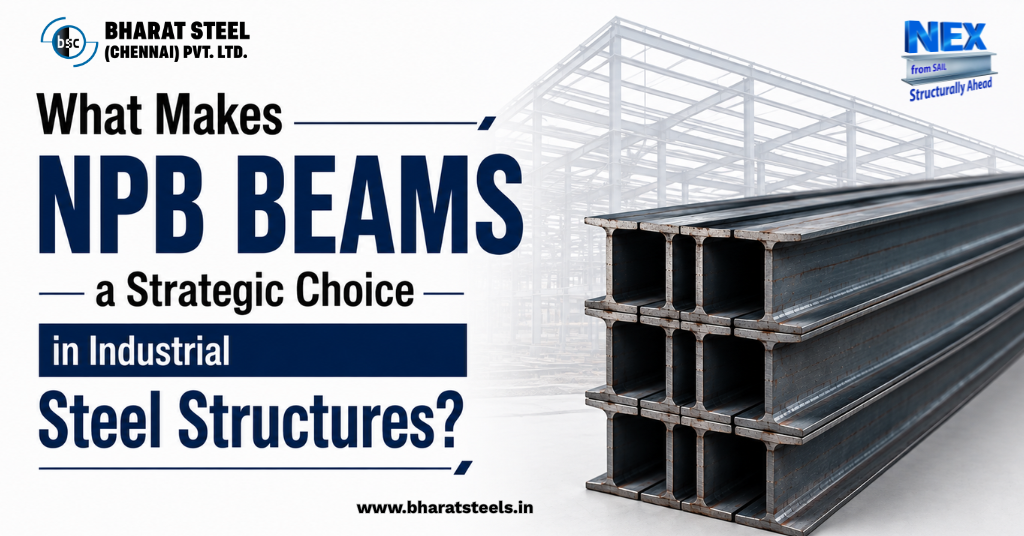
With their parallel-flange profile and range of available sections, NPB Beams can be considered for structural applications where the geometry and section properties suit the design. They can find relevance in industrial buildings, warehouses, roof-support applications, bridge structures and other fabricated steel systems, depending on the project requirements.
For projects in Chennai, Bharat Steel Chennai deals in NPB Beams as part of its structural steel range, with NPB sections available in a range of sizes and weights. This gives fabricators, contractors and project procurement teams an additional structural-steel option to consider when developing their material requirements.
But the interesting part is not simply that NPB Beams are available.
Start With the Structure, Not the Section
A common mistake in steel procurement is to begin with the material catalogue.
A better starting point is the building.
What is the span? What loads will the member carry? How is it supported? What type of connection is required? How will it be fabricated? What happens when the member reaches the site?
These questions determine whether a particular beam section is appropriate.
NPB Beams may be an excellent solution for one application and unnecessary for another. Its suitability depends on the engineering requirements rather than simply its name or weight.
This way of looking at beam selection is especially important in industrial projects, where even a small change in structural section can affect fabrication drawings, connection details, material quantities, transportation and erection.
What Makes an NPB Beam Different?
NPB Beams stand for Narrow Parallel Beams and are characterised by their parallel-flange geometry.
The defining feature is its parallel-flange geometry. The flanges run parallel rather than following a tapered arrangement, giving the section a consistent profile along its length.
That consistency matters when a beam must become part of a fabricated structure.
A structural steel beam does not work alone. It connects to columns, plates, stiffeners, secondary members and other components. Its geometry therefore influences how those connections are detailed and produced.
For a fabricator, predictable dimensions can make repeated operations easier to organise.
For an engineer, the available range of sections provides different options when working toward the required structural capacity.
For a buyer, the section designation provides a clear specification for procurement.
The advantage is therefore not one isolated property. It is the way the section fits into the larger workflow.
Why Parallel Flanges Can Be Useful in Fabrication
The fabrication floor is where a selected beam section must prove its practicality. Once the structural requirement is finalised, the beam moves through cutting, drilling, connection preparation, welding, inspection and dispatch. When the same section is used repeatedly across a project, consistency in geometry and dimensions becomes particularly important for maintaining fabrication accuracy.
This is one area where the range of NPB Beams available through Bharat Steel Chennai becomes relevant to project planning. Its listed MS Beam range includes NPB sections across different depths and weight categories, giving fabricators and project teams different section options to evaluate against their structural requirements.
Depending on the design, these sections may be considered for applications such as roof support structures and bridge support systems, which are among the applications identified by Bharat Steel Chennai for its NPB range.
From a fabrication perspective, the parallel-flange geometry can also provide a consistent base for detailing elements such as:
- End plates
- Stiffeners
- Brackets
- Connection plates
- Beam-to-column connections
- Beam-to-beam connections
That does not mean every NPB connection will automatically be simpler. The actual fabrication method still depends on the loads, connection design, welding or bolting requirements, tolerances and overall structural arrangement.
The real advantage is that the fabricator begins with a clearly defined section and can plan the downstream work around its actual dimensions and properties. In a project where multiple NPB sizes are required, having access to a broader range of sections can also make procurement decisions more closely aligned with the structural design.
The Beam Weight Is Not the Whole Story
Weight is an important consideration when purchasing structural steel, but it should not be the only measure used to compare beam sections.
A lighter section may appear more economical at the procurement stage, yet that advantage can change if it demands more complicated connections, additional stiffening, greater fabrication effort, or more time during erection.
A more realistic comparison is therefore the overall installed cost, which considers the complete journey of the beam:
Material → Fabrication → Handling → Transportation → Erection
This broader view helps project teams assess whether a particular section is delivering value after all the associated work is considered.
For NPB Beams, the decision should similarly be based on how well the section’s structural properties, geometry and weight match the intended application. If the selected section satisfies the design requirements while keeping fabrication and installation practical, its value can extend well beyond the initial cost per tonne.
Where NPB Beams Can Fit into Industrial Construction
Industrial structures very considerably, so there is no single application that defines an NPB Beam.
NPB Beams can be considered for applications such as:
Factories and production buildings often contain complex combinations of structural and operational loads.
A beam may support part of the primary frame, a platform, an internal floor or another structural component.
The appropriate NPB section needs to be determined from the actual loading and support conditions.
Warehouse structures place considerable emphasis on efficient use of space.
The structural framing must work around storage requirements, movement areas, loading zones and other operational considerations.
Where the calculated span and loading requirements are compatible, NPB sections can form part of the structural framing.
Platforms and mezzanine floors can introduce concentrated loads and specific deflection requirements.
Here, engineers need to consider not just whether the beam can carry the load, but also how much it deflects and how the member connects to the surrounding structure.
For projects involving custom in mezzanine Structure warehousing facilities, the beam selection also needs to work with the overall framing, access requirements, and intended use of the space.
Equipment Support Structures
Industrial equipment can create loading conditions that differ from ordinary building floors.
The beam selection may need to account for equipment loads, support conditions and service requirements.
This is another situation where the correct section can only be determined after the structural requirements are understood.
Why Section Availability Matters to Project Planning
Structural design and steel procurement are more closely connected than they may initially appear.
A beam selected during the design stage still must be sourced, delivered, fabricated, and made available when the project needs it. If a specified section is difficult to procure or its delivery does not match the construction schedule, the project team may have to reconsider the material plan or evaluate an alternative.
That can lead to more than a simple purchasing delay. Any change in section may require engineering review, connection checks, drawing revisions, procurement changes, and coordination with the fabrication team.
This is why material availability is worth considering early, particularly when a project involves large quantities of structural steel or follows a tightly planned construction schedule.
For NPB Beams, the practical approach is to confirm the required section size, grade, quantity, delivery timeline, and project-specific requirements before finalising procurement.
The goal is not to select a beam simply because it is available. It is to make sure that the selected section can move from design to procurement to fabrication without creating avoidable disruption to the project schedule.
What Fabricators Should Check Before Procurement
Once the structural engineer has specified the section, procurement still has several details to verify.
1. Section Designation
The exact NPB size should match the approved structural drawings.
2. Unit Weight
The specified section weight should correspond with the design and procurement requirement.
3. Material Grade
The required grade should be confirmed against the project specification.
4. Quantity
The total requirement should be coordinated with the fabrication schedule.
5. Length Requirements
Available stock lengths and cutting requirements can affect material utilisation.
6. Delivery Schedule
Material should reach the fabrication facility in line with the production plan.
7. Documentation
The project team should identify the material documentation required for inspection and quality records.
These checks may sound basic, but they become increasingly important as project quantities increase.
NPB Beams and Material Efficiency
There is an important difference between using less steel and using steel efficiently.
Reducing the section size without checking its structural performance is not optimisation. A properly engineered solution looks at how the selected member performs within the complete structure while also considering fabrication, connections and installation requirements.
For example, a slightly heavier beam that simplifies the connection or reduces fabrication complexity may prove more economical overall than a lighter section that requires additional work.
The same principle applies when considering how primary structural members interact with secondary components such as purlins. The efficiency of one member should not be judged in isolation; the overall structural arrangement needs to work as a coordinated system.
What Happens After the Beam Leaves the Stockyard?
Procurement is only the beginning. Once the beam reaches the fabrication floor, its suitability also depends on how accurately it can be converted into the required structural component.
The fabrication process may include:
Inspection → Marking → Cutting → Drilling → Fit-up → Welding → Quality Inspection → Surface Treatment → Dispatch
Each stage contributes to the accuracy of the finished member. Incorrect dimensions, misaligned components, or poorly executed connections can create difficulties during erection and may require rework at the site.
This is why fabrication needs to be supported by clear drawings, accurate measurements, controlled processes, and proper inspection at critical stages.
Good fabrication drawings, controlled processes and accurate measurements are therefore just as important as selecting the correct section.
Connections Can Change the Economics of a Beam
Two beams with similar structural capacity may not have identical fabrication requirements.
The difference can appear in the connection.
Consider a beam that needs to connect to a column using plates and stiffeners. The geometry of the beam affects the detailing of those components, while the connection itself must transfer the required forces safely.
This means the structural engineer and fabricator should ideally consider connection practicality during section selection.
For industrial projects with repetitive framing, even a small improvement in connection simplicity can become significant when multiplied across many joints.
How Engineers Should Evaluate NPB Beams
Before specifying an NPB Beam, engineers should work through the actual structural requirements.
Loading
What permanent, imposed, equipment or environmental loads will the member experience?
Span
How far does the beam need to span between supports?
Support Conditions
Is the beam simply supported, continuous or part of a more complex frame?
Bending and Shear
Does the selected section provide adequate resistance for the governing design conditions?
Deflection
Will the expected deflection remain within the applicable serviceability requirements?
Stability
Are relevant buckling and lateral stability conditions adequately addressed?
Connections
Can the proposed connection transfer the required forces while remaining practical to fabricate?
Availability
Can the required size and grade be sourced within the project’s schedule?
This approach prevents the beam selection from becoming a catalogue-driven decision.
NPB Beams vs Other Beam Sections
There is no universal winner when comparing structural sections.
An NPB Beam may be preferable for one project, while another section may provide a better solution elsewhere.
The comparison should consider:
| Consideration | NPB Beam | Other Beam Section |
| Flange geometry | Parallel | Depends on section |
| Connection arrangement | Depends on design | Depends on design |
| Structural capacity | Section-specific | Section-specific |
| Fabrication | Application-dependent | Application-dependent |
| Material efficiency | Depends on design | Depends on design |
| Availability | Depends on market and size | Depends on market and size |
| Final selection | Engineering-led | Engineering-led |
This is a more useful comparison than simply asking which beam is “stronger.”
A Practical Way to Think About NPB Beam Selection
For fabricators and project buyers, a simple three-stage approach can help.
First: Confirm the Engineering Requirement
Do not begin with the available stock list. Begin with the approved structural design.
Second: Check the Practical Fit
Evaluate whether the section works with the connection design, fabrication equipment, handling arrangements and erection plan.
Third: Confirm Procurement
Once the section is technically suitable, check size, grade, quantity, availability, delivery and documentation.
This sequence reduces the possibility of selecting a section that looks suitable on paper but becomes difficult during fabrication or procurement.
Conclusion
NPB Beams can be a practical choice for industrial steel structures when their parallel-flange profile and section properties align with the project’s structural requirements. But choosing an NPB Beam should go beyond simply comparing beam size, weight, or market availability.
The right selection comes from looking at the complete project requirement including structural calculations, connection details, fabrication requirements, procurement, transportation, and site erection. When these factors are considered together, the beam becomes part of a well-coordinated structural solution rather than just another item on a steel purchase list.
For fabricators, contractors, and industrial project teams in Chennai, Bharat Steel Chennai provides NPB Beams for applications where these sections meet the required structural specifications. If you are planning an industrial steel project and are evaluating NPB Beams, get in touch with Bharat Steel Chennai to discuss your requirement and enquire about suitable sections and availability.
Frequently Asked Question
1. What are NPB Beams used for?
NPB Beams can be used in industrial steel structures, roof-support systems, platforms, warehouses, and other applications depending on the design requirements.
2. What should be considered when selecting an NPB Beam?
Section size, structural loads, connections, deflection, fabrication requirements, availability, and erection should all be considered.
3. Are NPB Beams suitable for fabrication?
Their parallel-flange profile can provide a consistent geometry for connection detailing and fabrication, subject to the specific project requirements.
4. Should NPB Beams be selected based only on weight?
The most economical section should be evaluated based on its overall structural performance, fabrication, handling, and installation requirements.