Skip to content

Bharat Steels

Blog

  • Home
  • About Us
  • Long Products
    • TMT Rebars
    • M.S.Angles
    • M.S.Channels
    • M.S.Beams
    • M.S.Rounds
  • Flat Products
    • H.R.Sheets
    • M.S.Plates
    • MS Flates / GI Flates
    • Chequered Plates
  • Weight Calculator
  • Roofing
  • PEB
  • Blog
  • Contact
  • Download
Bharat Steels

Tag: Industrial Construction

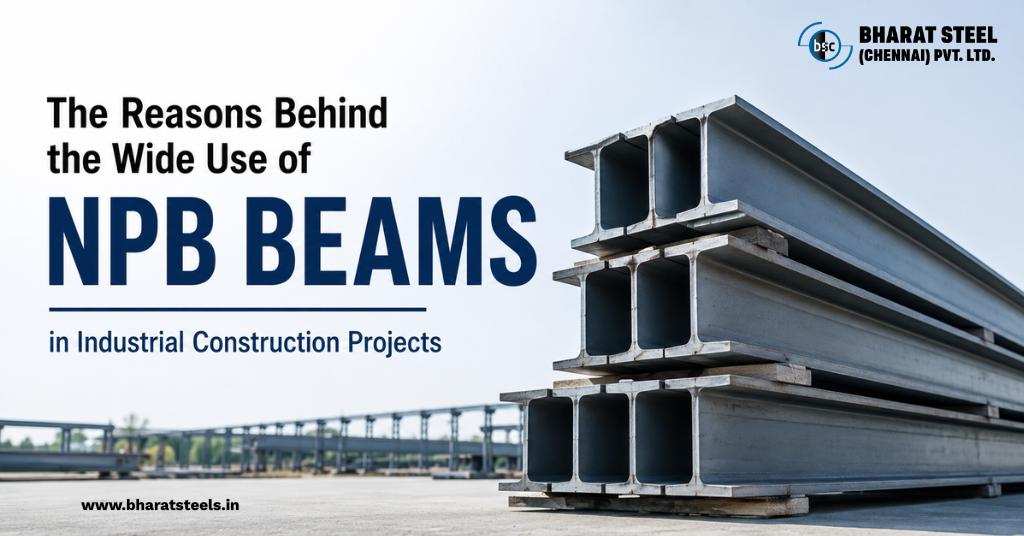
The Reasons Behind the Wide Use of NPB Beams in Industrial Construction Projects 

July 4, 2026
NPB Beams

Industrial construction projects demand structural components that can safely carry heavy loads, support long spans, and withstand demanding operating conditions. From manufacturing facilities and logistics parks to warehouses and pre-engineered buildings, selecting the right structural steel section directly influences a building’s safety, efficiency, and lifecycle cost. 

Among the various structural steel sections available today, NPB Beams have become a preferred choice for engineers, architects, fabricators, and industrial developers. Their parallel flange design, high load-bearing capacity, and compatibility with modern steel construction make them an ideal solution for projects requiring durability, speed of construction, and optimized structural performance. 

Whether designing a new factory, expanding warehouse capacity, or constructing a mezzanine floor, understanding why NPB Beams are widely used can help project stakeholders make better engineering and procurement decisions. 

Understanding the Geometry of NPB Beams 

One of the defining characteristics of an NPB Beam is its parallel flange profile. Unlike tapered flange sections, parallel flanges create a more uniform distribution of stresses across the beam, improving structural efficiency and simplifying fabrication. 

This geometry offers several practical advantages: 

  • Better resistance to bending moments 
  • Improved load distribution across the section 
  • Easier welding and bolted connections 
  • Enhanced compatibility with steel fabrication processes 
  • Greater flexibility in industrial structural design 

Because of these characteristics, NPB Beams integrate seamlessly into modern steel framing systems, especially in projects where precision, speed, and reliability are essential. 

The wider flange profile of NPB Beams improves both structural performance and fabrication efficiency, making them particularly suitable for large industrial facilities. 

Why Are NPB Beams Widely Used in Industrial Construction? 

Industrial buildings are expected to accommodate heavy machinery, cranes, storage systems, mezzanine floors, and dynamic operational loads. Structural steel sections used in these environments must perform reliably throughout the building’s service life. 

NPB Beams address these demands by providing a combination of strength, stability, and construction efficiency that aligns well with contemporary industrial design practices. 

1. Superior Load-Carrying Capacity 

One of the most significant advantages of NPB Beams is their ability to support substantial structural loads. 

Their optimized cross-sectional geometry enables efficient transfer of vertical and horizontal forces, reducing localized stress concentrations while maintaining overall structural stability. 

This makes them particularly suitable for: 

  • Industrial warehouses 
  • Manufacturing plants 
  • Heavy-duty production facilities 
  • Multi-level steel structures 
  • Material handling systems 

When properly selected by structural engineers, NPB Beams help ensure that buildings safely withstand both static and dynamic loading conditions. 

2. Excellent Strength-to-Weight Ratio 

Modern construction increasingly emphasizes structural efficiency rather than simply using larger quantities of steel. 

NPB Beams offer an effective balance between material usage and structural performance. Their design enables engineers to achieve higher load capacities without unnecessary increases in structural weight. 

This contributes to: 

  • Material optimization 
  • Reduced dead load 
  • More efficient structural framing 
  • Better foundation design 
  • Improved overall project economics 

Rather than relying on oversized structural members, designers can often achieve the required performance using optimized beam sections. 

3. Better Performance Across Longer Spans 

Industrial facilities frequently require wide open spaces with minimal internal columns to maximize operational flexibility. 

NPB Beams are well suited for longer spans because they provide higher bending resistance and structural stiffness compared to many conventional sections. 

This enables: 

  • Flexible warehouse layouts 
  • Efficient production lines 
  • Larger storage areas 
  • Improved equipment movement 
  • Better utilization of floor space 

For industries that regularly reconfigure production layouts, fewer internal columns translate into greater long-term adaptability. 

4. Faster Fabrication and Installation 

Project schedules have become increasingly demanding, making construction speed a critical factor in industrial developments. 

Because of their standardized dimensions and parallel flange geometry, NPB Beams simplify fabrication activities such as: 

  • Cutting 
  • Welding 
  • Drilling 
  • Bolting 
  • Assembly 

This improves coordination between structural designers, fabrication workshops, and on-site erection teams, helping reduce installation time without compromising quality. 

Efficient fabrication also minimizes the likelihood of dimensional inconsistencies during assembly. 

5. Compatibility with Modern PEB Structures 

Pre-Engineered Buildings  have transformed industrial construction by offering faster project execution, optimized material usage, and predictable structural performance. 

NPB Beams integrate effectively into PEB systems because they work well with: 

  • Primary framing members 
  • Secondary steel systems 
  • Mezzanine floor structures 
  • Crane support frameworks 
  • Roof and wall framing assemblies 

Their versatility makes them suitable for both new industrial developments and expansion projects. 

How NPB Beams Improve Industrial Structural Performance 

Selecting an appropriate structural steel section affects far more than the building’s immediate strength. It influences construction speed, lifecycle costs, maintenance requirements, and future expansion possibilities. 

NPB Beams contribute to improved structural performance by enhancing how loads are transferred throughout the steel framework while maintaining dimensional stability under service conditions. 

Efficient Load Transfer 

Every industrial structure depends on effective load transfer from the roof and floors through beams, columns, and foundations. 

NPB Beams distribute loads more uniformly due to their parallel flange configuration and optimized cross-sectional geometry. This improves overall structural behavior and helps reduce localized stress concentrations at beam-column connections. 

The result is a structural system that performs more predictably under varying operational conditions. 

Reduced Structural Deflection 

Excessive beam deflection can create serviceability issues, affect equipment alignment, and reduce occupant confidence in the structure. 

When properly designed and specified, NPB Beams provide improved stiffness, helping limit deflection under working loads while maintaining structural integrity. 

This characteristic is particularly valuable in facilities housing: 

  • Precision manufacturing equipment 
  • Automated storage systems 
  • Overhead material handling 
  • Mezzanine office floors 

Improved Beam-to-Column Connections 

Connection detailing plays a significant role in structural reliability. 

The parallel flange profile of NPB Beams simplifies welding and bolted connections, allowing fabricators to achieve greater dimensional accuracy during manufacturing. 

Well-executed connections contribute to: 

  • Improved structural continuity 
  • Faster site erection 
  • Better quality control 
  • Reduced fabrication complexity 

Better Resistance to Industrial Loading Conditions 

Industrial facilities experience a combination of static loads, moving equipment, storage loads, vibration, and occasional impact forces. 

NPB Beams are commonly selected because they provide dependable structural performance under these demanding operating conditions when incorporated into a properly engineered structural design. 

Common Applications of NPB Beams in Industrial Construction 

As industrial facilities continue to evolve, buildings must accommodate larger equipment, automated storage systems, and flexible layouts. NPB Beams help engineers meet these requirements while maintaining structural safety and optimizing steel consumption. 

1. Industrial Warehouses 

Warehouses demand large unobstructed floor areas to maximize storage efficiency and improve material movement. NPB Beams support long roof spans with fewer intermediate columns, allowing forklifts, racking systems, and logistics equipment to operate efficiently. 

Their high bending resistance makes them particularly suitable for: 

  • Distribution centers 
  • E-commerce fulfillment warehouses 
  • Cold storage facilities 
  • Bulk storage buildings 

2. Manufacturing Plants 

Factories house heavy machinery, overhead utilities, and production equipment that generate significant structural loads. 

NPB Beams provide the strength required to safely support: 

  • Production machinery 
  • Utility platforms 
  • Service walkways 
  • Crane-supporting structures 
  • Equipment maintenance areas 

Their dimensional stability also contributes to improved structural performance in facilities operating continuously under demanding conditions. 

3. Pre-Engineered Buildings (PEB) 

Modern PEB construction prioritizes speed, precision, and optimized material utilization. 

NPB Beams integrate effectively into PEB systems because they are compatible with: 

  • Primary framing 
  • Secondary steel members 
  • Roof framing 
  • Wall framing 
  • Mezzanine systems 

Their standardized dimensions simplify fabrication and installation, supporting faster project completion. 

4. Mezzanine Floors 

Many industrial buildings require additional floor space without expanding the building footprint. 

NPB Beams are commonly incorporated into mezzanine structures because they offer: 

  • High floor load capacity 
  • Reduced vibration 
  • Reliable structural stiffness 
  • Flexible layout options 

Applications include: 

  • Office mezzanines 
  • Storage platforms 
  • Equipment floors 
  • Assembly areas 

5. Heavy Industrial Facilities 

Industries such as steel processing, automotive manufacturing, cement production, and engineering workshops often expose structures to substantial operational loads. 

NPB Beams perform well in facilities containing: 

  • Heavy equipment 
  • Large material handling systems 
  • Process machinery 
  • Dynamic operational loading 

6. Commercial and Institutional Steel Buildings 

Although widely associated with industrial construction, NPB Beams are also used in commercial developments requiring large column-free spaces. 

Examples include: 

  • Exhibition halls 
  • Shopping complexes 
  • Sports arenas 
  • Aircraft hangars 
  • Large retail outlets 

Expert Insights from Industrial Construction Projects 

While beam selection begins with structural calculations, successful industrial projects often depend on practical execution. 

Based on common industry practices, experienced engineers and project managers generally recommend the following: 

Prioritize Lifecycle Value 

Selecting a beam solely because it has the lowest purchase price may increase fabrication complexity, maintenance requirements, or future modification costs. 

Instead, evaluate: 

  • Structural efficiency 
  • Installation time 
  • Maintenance requirements 
  • Future expansion possibilities 
  • Overall project lifecycle cost 

Coordinate Early with Fabricators 

Many construction challenges arise because fabrication teams become involved only after structural drawings are finalized. 

Early collaboration helps: 

  • Simplify connection details 
  • Improve fabrication efficiency 
  • Reduce site modifications 
  • Shorten project timelines 

Maintain Documentation Throughout the Project 

Retaining records such as: 

  • Material certificates 
  • Inspection reports 
  • Welding procedures 
  • Quality control documentation 

Supports future maintenance, audits, and structural modifications. 

Design for Future Expansion 

Many industrial facilities expand within a few years of commissioning. 

Where practical, engineers often consider: 

  • Additional floor loads 
  • Future mezzanine extensions 
  • Equipment upgrades 
  • Crane installations 
  • Building extensions 

Planning for future growth during the initial design stage can reduce structural modifications later. 

Common Mistakes When Selecting NPB Beams 

Even high-quality structural steel cannot compensate for poor engineering decisions or inadequate planning. 

Avoid these common mistakes: 

Choosing Beams Based Only on Price 

Lower material cost does not necessarily reduce total project cost. 

Factors such as fabrication, transportation, erection, maintenance, and lifecycle performance should also be considered. 

Ignoring Structural Load Calculations 

Beam selection should always be based on engineering analysis rather than assumptions or previous projects. 

Each structure has unique: 

  • Loading conditions 
  • Span requirements 
  • Serviceability criteria 
  • Environmental considerations 

Selecting Incorrect Beam Sizes 

Oversized beams increase material costs unnecessarily, while undersized members may compromise structural performance. 

Proper structural optimization balances safety, efficiency, and economy. 

Overlooking Corrosion Protection 

Industrial environments vary considerably. 

Structures exposed to moisture, chemicals, or coastal conditions require appropriate protective coatings and maintenance strategies. 

Purchasing Without Material Certification 

Accepting structural steel without verifying documentation introduces unnecessary project risk. 

Always confirm: 

✔ Mill Test Certificates 

✔ Material traceability 

✔ Applicable standards 

✔ Dimensional compliance 

Neglecting Future Operational Requirements 

Industrial buildings often evolve. 

Selecting beams without considering future equipment, storage, or expansion requirements may increase modification costs later. 

Conclusion 

NPB Beams have become an integral component of modern industrial construction because they combine structural efficiency, fabrication convenience, and long-term durability. Their parallel flange design improves load distribution, simplifies fabrication, and supports the demanding requirements of warehouses, manufacturing facilities, PEB structures, and large commercial buildings. 

However, selecting the right beam involves more than comparing dimensions. Successful projects depend on sound engineering calculations, adherence to recognized standards, careful procurement planning, and ongoing maintenance. Sourcing structural steel from a reliable distributor that provides certified materials, consistent availability, and technical documentation also plays an important role in project success. Contact Bharat Steel Chennai, as a Structural Steel Distributor, supports industrial projects by helping contractors, fabricators, and procurement teams source quality structural steel sections with the documentation and supply reliability needed for efficient project execution. 

When engineering expertise, quality materials, and dependable procurement practices come together, NPB Beams offer a reliable structural solution for building safe, efficient, and future-ready industrial infrastructure. 

Frequently Asked Questions 

Q. What are NPB Beams used for? 

NPB Beams are primarily used in warehouses, factories, PEB structures, mezzanine floors, commercial buildings, and heavy industrial facilities where high structural strength and long spans are required. 

Q.Are NPB Beams stronger than ISMB Beams? 

NPB Beams generally provide better load distribution and higher structural efficiency due to their parallel flange design. However, the appropriate choice depends on engineering calculations and project requirements. 

Q.Why are NPB Beams preferred in warehouses? 

Their ability to support long spans with fewer columns creates larger unobstructed floor spaces, improving storage efficiency and operational flexibility. 

Q. Which standards should buyers verify before purchasing? 

Buyers should verify compliance with applicable standards such as IS 808 and request Mill Test Certificates along with other quality documentation specified for the project. 

Q. How long do NPB Beams last? 

With appropriate design, corrosion protection, and periodic maintenance, NPB Beams can provide reliable structural performance over several decades. 
Blog, NPB Beams Industrial Construction, NPB Beams

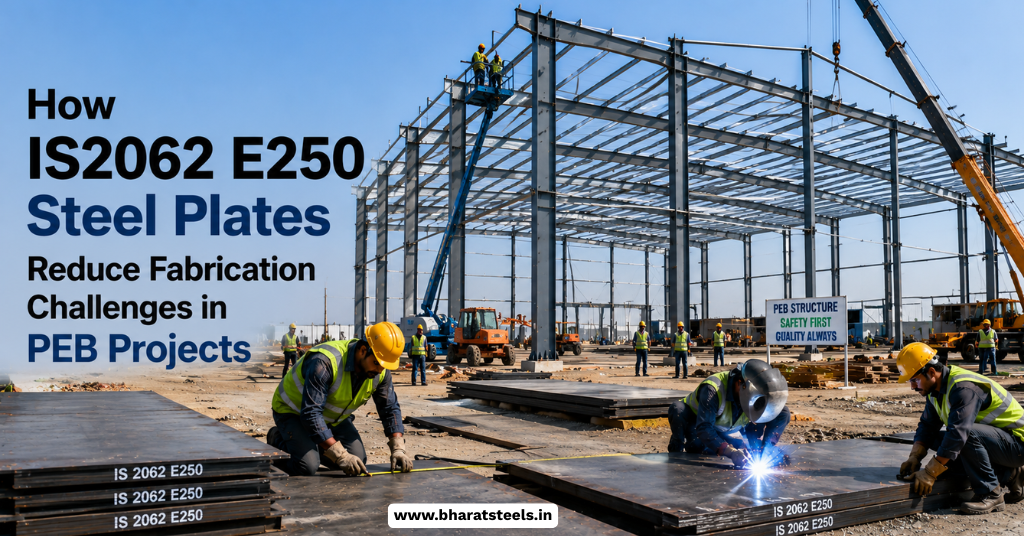
How IS2062 E250 Steel Plates Reduce Fabrication Challenges in PEB Projects 

June 16, 2026
IS 2062 E250 steel plates

Fabrication efficiency plays a critical role in the success of any Pre-Engineered Building project. From manufacturing primary structural members to assembling built-up sections, every stage depends on material quality, dimensional consistency, and ease of processing. Even minor fabrication issues can lead to production delays, increased labor costs, rework, and installation challenges at project sites. 

Among the various structural materials used in PEB manufacturing, IS 2062 E250 steel plates have become one of the most preferred choices for fabricators and PEB manufacturers. Their balanced mechanical properties, good weldability, and fabrication-friendly characteristics help streamline manufacturing operations while maintaining structural reliability. 

This content highlights how IS 2062 E250 steel plates help reduce common fabrication challenges in modern PEB projects. 

Understanding IS 2062 E250 Steel Plates 

IS 2062 E250 is a widely adopted structural steel grade in India, commonly selected for fabrication, industrial infrastructure, and engineered construction projects. 

The grade is known for offering: 

  • Good yield strength  
  • Excellent weldability  
  • Reliable structural performance  
  • Easy machinability  
  • Consistent fabrication behavior  

Because of these characteristics, E250 steel plates are commonly used in: 

  • Built-up columns  
  • Built-up rafters  
  • End frames  
  • Crane support structures  
  • Mezzanine systems  
  • Industrial sheds  
  • Warehouse buildings  

Common Fabrication Challenges in PEB Manufacturing 

Before understanding the advantages of E250 plates, it is important to recognize the challenges fabrication teams frequently encounter. 

Welding Difficulties 

Poor-quality materials or unsuitable grades often create welding complications such as: 

  • Weld defects  
  • Excessive heat distortion  
  • Cracking risks  
  • Inconsistent weld penetration  

These issues can affect both fabrication quality and project timelines. 

Dimensional Variations 

Structural members require precise dimensions for proper assembly. 

Inconsistent plate dimensions can result in: 

  • Alignment problems  
  • Rework requirements  
  • Poor fit-up during fabrication  
  • Increased assembly time  

Excessive Processing Time 

Some grades require additional preparation during: 

  • Cutting  
  • Drilling  
  • Machining  
  • Welding  

This increases fabrication costs and reduces productivity. 

Material Handling Challenges 

Large-scale PEB developments typically require substantial volumes of structural steel plates throughout the fabrication process. 

How IS 2062 E250 Steel Plates Improve Weldability 

One of the biggest advantages of IS 2062 E250 steel plates is their excellent weldability. 

PEB structures involve thousands of welded joints across columns, rafters, bracing systems, and connection assemblies. Materials with good welding characteristics help fabrication teams achieve consistent weld quality with fewer complications. 

Benefits include: 

  • Better weld penetration  
  • Reduced risk of cracking  
  • Improved weld consistency  
  • Faster welding operations  
  • Lower repair requirements  

As a result, fabrication shops can maintain higher productivity while achieving reliable structural performance. 

Reduced Distortion During Fabrication 

Heat distortion is a common challenge when manufacturing built-up sections. 

Because E250 plates offer balanced mechanical properties, fabrication teams can better control deformation during: 

  • Welding  
  • Flame cutting  
  • Assembly operations  

This reduces: 

  • Straightening work  
  • Re-fabrication requirements  
  • Shop-floor delays  

These improvements contribute to smoother fabrication workflows and better manufacturing efficiency. 

Improved Fit-Up Accuracy in Built-Up Sections 

Built up columns and rafters require precise assembly of multiple plate components. 

Dimensional consistency in E250 steel plates helps fabricators achieve: 

  • Better alignment  
  • Accurate fit-up  
  • Reduced assembly errors  
  • Faster fabrication cycles  

Improved fit-up quality also reduces the likelihood of site erection issues later in the project. 

Easier Machining and Processing 

PEB components often require additional processing such as: 

  • Hole drilling  
  • Slot preparation  
  • Edge finishing  
  • Connection detailing  

IS 2062 E250 steel plates offer good machinability, allowing these operations to be performed efficiently without excessive tool wear or processing delays. 

This contributes to smoother production workflows and improved manufacturing output. 

Enhanced Structural Reliability 

Fabrication efficiency must always be balanced with steel performance. 

E250 plates provide dependable mechanical properties that make them suitable for: 

  • Industrial buildings  
  • Warehouses  
  • Manufacturing plants  
  • Logistics facilities  
  • Commercial structures  

Consistent material quality helps ensure that fabricated components meet both design requirements and project specifications. 

Reduced Rework and Material Waste 

One of the hidden costs in fabrication is rework. 

Common causes include: 

  • Welding defects  
  • Dimensional inaccuracies  
  • Processing errors  
  • Assembly issues  

The fabrication-friendly nature of E250 steel plates helps minimize these problems, reducing: 

  • Material wastage  
  • Labor costs  
  • Production delays  
  • Quality control issues  

Lower rework levels contribute directly to improved project profitability. 

Faster Production Cycles for PEB Manufacturers 

Many PEB developments are executed with strict completion targets. Fabrication-friendly materials help accelerate production activities and support timely project delivery. 

Because E250 steel plates offer: 

  • Easy processing  
  • Reliable weldability  
  • Consistent dimensions  
  • Good machinability  

Fabricators can accelerate production without compromising quality. 

This is particularly beneficial for large industrial projects where production efficiency directly affects delivery commitments. 

Supporting Quality Control Processes 

Quality control teams play an important role in PEB manufacturing. 

Consistent material properties simplify inspection activities such as: 

  • Dimensional verification  
  • Weld inspection  
  • Fit-up checks  
  • Structural compliance reviews  

Using reliable structural plates reduces variability and makes quality assurance processes more effective. 

Why E250 Steel Plates Are Widely Preferred in PEB Projects 

PEB manufacturers continue to prefer IS 2062 E250 steel plates because they offer a practical balance between: 

  • Strength  
  • Weldability  
  • Fabrication efficiency  
  • Availability  
  • Cost-effectiveness  

These advantages make the grade suitable for both medium-scale and large-scale industrial building projects. 

Conclusion 

IS 2062 E250 steel plates help address many of the common challenges encountered in PEB fabrication by providing excellent weldability, dimensional consistency, machinability, and structural reliability. 

For fabrication units, PEB manufacturers, and industrial contractors, the use of E250 steel plates supports efficient manufacturing operations, improved component quality, reduced material losses, and timely project execution. 

At the same time, sourcing trusted structural steel from suppliers like supports long-term project efficiency and quality consistency. For inquiries or assistance, you can reach us through our Contact Page. 

Frequently Asked Questions (FAQs) 

What are IS 2062 E250 steel plates used for in PEB projects? 

They are commonly used for built-up columns, rafters, end frames, mezzanine systems, crane structures, and other structural components. 

Why are E250 steel plates preferred for fabrication? 

They offer good weldability, machinability, dimensional consistency, and ease of processing, which helps improve fabrication efficiency. 

Do E250 steel plates reduce welding challenges? 

Yes. Their excellent weldability helps reduce weld defects, distortion, cracking risks, and repair work. 

How do E250 steel plates improve project timelines? 

Their fabrication-friendly characteristics help reduce processing time, minimize rework, and improve overall production efficiency.

Blog, IS 2062 E250 Steel Plates Industrial Construction, IS2062 E250 Steel

How E250 Steel Meets the Needs of Modern Industrial Construction

March 31, 2026
E250 Steel

In industrial construction, the goal isn’t just to build something strong, it’s to do it efficiently, without overspending or slowing down the project. In reality, many projects end up using higher-grade steel than necessary, which increases both material costs and fabrication time without adding real value.

That’s why E250 Steel is widely preferred across the industry. It offers just the right combination of strength, ease of fabrication, and cost control for most structural needs. Whether it’s warehouses, PEB buildings, or general fabrication work, E250 helps teams complete projects faster while keeping budgets in check.

What is E250 Steel and Why Is It Widely Used in Industrial Construction?

Structural steel grade E250 is classified under Indian Standard 2062 with a minimum yield strength of 250 megapascals (MPa). Also, it has considerable application in the construction and fabrication of industrial buildings.

E250 Steel is frequently utilized in:

  • Warehouses
  • Production Facilities
  • PEB Structures
  • Fabrication Components

In simple terms , this is one of the best types of steel for use in industrial construction, except that it doesn’t require a significant amount of strength.

Why industries prefer E250 Grade Steel

  • Cost-effective steel for fabrication
  • Easy to weld and process
  • Easily available across India
  • Suitable for most structural applications

Key Properties of E250 Steel for Industrial Construction Projects

Load-Bearing Strength of E250 Steel in Structures

It provides reliable performance in terms of load-bearing strength with a yield strength of 250 MPa in: 

  • Industrial Sheds/Buildings
  • Warehouses
  • PEB Buildings

 It has the ability to provide the user with adequate strength while keeping down material costs, justifying its use under normal loads.

Weldability Benefits of E250 Grade Steel in Fabrication

One major benefit is that it has superior workability compared to other steels.

  • Welding is smooth and has very few defects
  • It is easy to work with by cutting, drilling and bending
  • The cycle time to produce fabricated parts is shorter

As a result of these factors, fabrication companies have lower labour costs and are more productive overall than other fabricators.

Durability and Life of E250 Steel in Industrial Construction

These Steel performs well in:

  • Indoor environments
  • Semi-exposed industrial conditions

An appropriate coat has excellent longevity,minimal maintenance, an ideal use as a mild steel construction material.

Applications of E250 Steel in Industrial Construction and Fabrication

Use of E250 Steel in PEB Structures

E250 Steel is widely used in:

  • Columns
  • Rafters
  • Bracing systems

It is a preferred choice for steel for PEB buildings due to its strength-to-cost ratio.

Applications of E250 Steel Plates in Fabrication

Steel Plates are essential for:

  • Base plates
  • Gusset plates
  • Machine structures

These plates are widely used as mild steel plates for structural use because they are easy to fabricate and install.

Applications of E250 MS Plate in Fabrication Work

In general engineering, They are used for:

  • Equipment platforms
  • Structural frames
  • Support structures

It is ideal for cost-effective steel for fabrication projects.

Advantages Of E250 Steel For Industrial Building

  • Demonstrated success under Indian conditions
  • Affordability for large structures
  • Easily fabricated and processed material
  • Widely available throughout the marketplace

When comparing between grades of steel, this grade offers a better return on investment due to lower costs and superior performance for the majority of industrial applications.

Cost Efficiency of E250 Steel in Large-Scale Projects

Controlling project costs is an important component of large-scale projects.

E250 type steel provides cost savings through:

  • Lower costs for raw material
  • Faster fabrication
  • Lower overall labor costs
  • Availability

This kind of Steel is therefore one of the materials of choice for contractors to manage a project with a limited budget and time frame.

Compliance and Quality Standards of E250 Grade Steel

IS 2062 Specifications for E250 Steel

IS 2062 defines the two major characteristics of E250 Steel Grade are:

  • Consistency of Quality
  • Consistency of Performance
  • Standardization of Properties

Quality Checks Before Buying E250 Steel Plates

When purchasing E250 Steel Plates you could potentially experience the following:

  • Mill Test Certificate
  • Thickness tolerances
  • Surface finish

These will help you prevent project cost overruns and quality problems.

How to Decide if E250 Steel is Right for Your Project

Use E250 Steel when:

  • For your Project, Under Standard Load Requirements
  • When You Need Cost-Effective Structural Steel
  • Where Speed of Fabrication is Important to You

Consider Higher Grade of Steel for:

  • If Your Structure Will Be Heavily Loaded

This Will Help You Find the Right Material for Your Industrial Steel Use.

Common Mistakes to Avoid When Buying

Avoid these common mistakes:

  • Confusing E250 with commercial-grade steel
  • Ignoring quality certifications
  • Choosing suppliers based only on price

These can lead to long-term structural issues and increased costs.

Where to Buy

Most industrial applications need a certain level of strength, but generally speaking they don’t need to achieve the highest possible level of strength, so choosing the correct grade of steel is crucial. With E250 Steel you can achieve the right level of strength for your application and also have a cost-effective and smoothly executed project. By using during production processes, a company can simplify the fabrication process and therefore reduce their costs, while keeping their projects running.

If you’re looking for a dependable supply of E250 Steel Contact Bharat Steel Chennai is a trusted E250 Steel supplier and they’ve had years of experience in delivering structural steel to industry.

Frequently Asked Questions ( FAQ):

Q. What is E250 Steel?

A.E250 Steel is a structural steel grade with 250 MPa yield strength used in industrial construction.

Q.Is E250 Steel good for warehouse construction?

A.Yes, it is one of the best steel options for warehouse and PEB structures.

Q.Where are E250 Steel Plates used?

A.They are used in base plates, gusset plates, and machine structures.

Q.Is the E250 MS Plate suitable for fabrication?

A.Yes, it is widely used due to its excellent weldability and ease of machining.

Blog, E250 Steel Grades E250 Steel Plates, E250 Steels, Industrial Construction

Recent Posts

  • The Reasons Behind the Wide Use of NPB Beams in Industrial Construction Projects 
  • The Role of Ready-to-Use Steel in Improving Erection Speed in Large PEB Projects 
  • Steel Dealers in Chennai Supporting Fast-Track EPC Construction and On-Site Fabrication Demands 
  • Steel Dealers in Chennai for Industrial Expansion Projects with Zero Delay Steel Procurement Strategy 
  • How IS2062 E250 Steel Plates Reduce Fabrication Challenges in PEB Projects 

Idealist by NewMediaThemes