
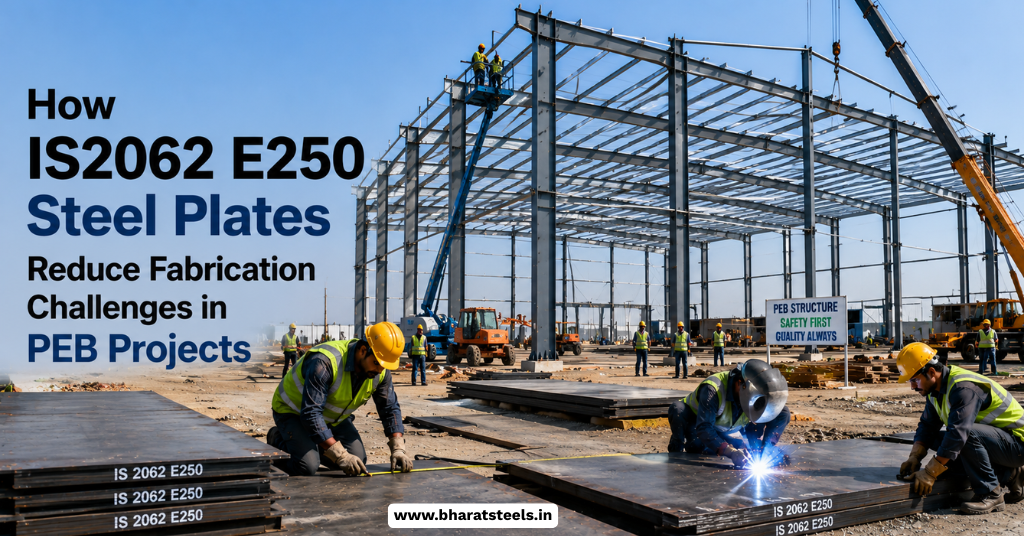
Fabrication efficiency plays a critical role in the success of any Pre-Engineered Building project. From manufacturing primary structural members to assembling built-up sections, every stage depends on material quality, dimensional consistency, and ease of processing. Even minor fabrication issues can lead to production delays, increased labor costs, rework, and installation challenges at project sites.
Among the various structural materials used in PEB manufacturing, IS 2062 E250 steel plates have become one of the most preferred choices for fabricators and PEB manufacturers. Their balanced mechanical properties, good weldability, and fabrication-friendly characteristics help streamline manufacturing operations while maintaining structural reliability.
This content highlights how IS 2062 E250 steel plates help reduce common fabrication challenges in modern PEB projects.
Understanding IS 2062 E250 Steel Plates
IS 2062 E250 is a widely adopted structural steel grade in India, commonly selected for fabrication, industrial infrastructure, and engineered construction projects.
The grade is known for offering:
- Good yield strength
- Excellent weldability
- Reliable structural performance
- Easy machinability
- Consistent fabrication behavior
Because of these characteristics, E250 steel plates are commonly used in:
- Built-up columns
- Built-up rafters
- End frames
- Crane support structures
- Mezzanine systems
- Industrial sheds
- Warehouse buildings
Common Fabrication Challenges in PEB Manufacturing
Before understanding the advantages of E250 plates, it is important to recognize the challenges fabrication teams frequently encounter.
Welding Difficulties
Poor-quality materials or unsuitable grades often create welding complications such as:
- Weld defects
- Excessive heat distortion
- Cracking risks
- Inconsistent weld penetration
These issues can affect both fabrication quality and project timelines.
Dimensional Variations
Structural members require precise dimensions for proper assembly.
Inconsistent plate dimensions can result in:
- Alignment problems
- Rework requirements
- Poor fit-up during fabrication
- Increased assembly time
Excessive Processing Time
Some grades require additional preparation during:
- Cutting
- Drilling
- Machining
- Welding
This increases fabrication costs and reduces productivity.
Material Handling Challenges
Large-scale PEB developments typically require substantial volumes of structural steel plates throughout the fabrication process.
How IS 2062 E250 Steel Plates Improve Weldability
One of the biggest advantages of IS 2062 E250 steel plates is their excellent weldability.
PEB structures involve thousands of welded joints across columns, rafters, bracing systems, and connection assemblies. Materials with good welding characteristics help fabrication teams achieve consistent weld quality with fewer complications.
Benefits include:
- Better weld penetration
- Reduced risk of cracking
- Improved weld consistency
- Faster welding operations
- Lower repair requirements
As a result, fabrication shops can maintain higher productivity while achieving reliable structural performance.
Reduced Distortion During Fabrication
Heat distortion is a common challenge when manufacturing built-up sections.
Because E250 plates offer balanced mechanical properties, fabrication teams can better control deformation during:
- Welding
- Flame cutting
- Assembly operations
This reduces:
- Straightening work
- Re-fabrication requirements
- Shop-floor delays
These improvements contribute to smoother fabrication workflows and better manufacturing efficiency.
Improved Fit-Up Accuracy in Built-Up Sections
Built up columns and rafters require precise assembly of multiple plate components.
Dimensional consistency in E250 steel plates helps fabricators achieve:
- Better alignment
- Accurate fit-up
- Reduced assembly errors
- Faster fabrication cycles
Improved fit-up quality also reduces the likelihood of site erection issues later in the project.
Easier Machining and Processing
PEB components often require additional processing such as:
- Hole drilling
- Slot preparation
- Edge finishing
- Connection detailing
IS 2062 E250 steel plates offer good machinability, allowing these operations to be performed efficiently without excessive tool wear or processing delays.
This contributes to smoother production workflows and improved manufacturing output.
Enhanced Structural Reliability
Fabrication efficiency must always be balanced with steel performance.
E250 plates provide dependable mechanical properties that make them suitable for:
- Industrial buildings
- Warehouses
- Manufacturing plants
- Logistics facilities
- Commercial structures
Consistent material quality helps ensure that fabricated components meet both design requirements and project specifications.
Reduced Rework and Material Waste
One of the hidden costs in fabrication is rework.
Common causes include:
- Welding defects
- Dimensional inaccuracies
- Processing errors
- Assembly issues
The fabrication-friendly nature of E250 steel plates helps minimize these problems, reducing:
- Material wastage
- Labor costs
- Production delays
- Quality control issues
Lower rework levels contribute directly to improved project profitability.
Faster Production Cycles for PEB Manufacturers
Many PEB developments are executed with strict completion targets. Fabrication-friendly materials help accelerate production activities and support timely project delivery.
Because E250 steel plates offer:
- Easy processing
- Reliable weldability
- Consistent dimensions
- Good machinability
Fabricators can accelerate production without compromising quality.
This is particularly beneficial for large industrial projects where production efficiency directly affects delivery commitments.
Supporting Quality Control Processes
Quality control teams play an important role in PEB manufacturing.
Consistent material properties simplify inspection activities such as:
- Dimensional verification
- Weld inspection
- Fit-up checks
- Structural compliance reviews
Using reliable structural plates reduces variability and makes quality assurance processes more effective.
Why E250 Steel Plates Are Widely Preferred in PEB Projects
PEB manufacturers continue to prefer IS 2062 E250 steel plates because they offer a practical balance between:
- Strength
- Weldability
- Fabrication efficiency
- Availability
- Cost-effectiveness
These advantages make the grade suitable for both medium-scale and large-scale industrial building projects.
Conclusion
IS 2062 E250 steel plates help address many of the common challenges encountered in PEB fabrication by providing excellent weldability, dimensional consistency, machinability, and structural reliability.
For fabrication units, PEB manufacturers, and industrial contractors, the use of E250 steel plates supports efficient manufacturing operations, improved component quality, reduced material losses, and timely project execution.
At the same time, sourcing trusted structural steel from suppliers like supports long-term project efficiency and quality consistency. For inquiries or assistance, you can reach us through our Contact Page.
Frequently Asked Questions (FAQs)
What are IS 2062 E250 steel plates used for in PEB projects?
They are commonly used for built-up columns, rafters, end frames, mezzanine systems, crane structures, and other structural components.
Why are E250 steel plates preferred for fabrication?
They offer good weldability, machinability, dimensional consistency, and ease of processing, which helps improve fabrication efficiency.
Do E250 steel plates reduce welding challenges?
Yes. Their excellent weldability helps reduce weld defects, distortion, cracking risks, and repair work.
How do E250 steel plates improve project timelines?
Their fabrication-friendly characteristics help reduce processing time, minimize rework, and improve overall production efficiency.